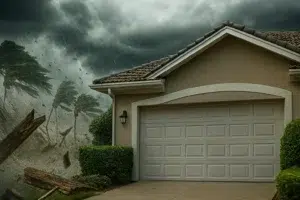
Hurricane season just started. You’ve got your water, your flashlights, maybe even your shutters. But what about your garage door? According to the Alliance for Safe Homes and FEMA data, about 80% of wind damage begins at the garage door. When a door buckles, wind rushes in and pressure builds inside your home. It can lift your roof off from the inside out, like a balloon popping. This is why a hurricane garage door South Florida matters for safety.
It’s not dramatic. It’s physics. And it’s documented.
NOAA 2026 Forecast: “It Only Takes One”
Yes, NOAA is forecasting a below-average 2026 Atlantic hurricane season — 8 to 14 named storms, with El Niño expected to suppress activity. That might sound reassuring.
It shouldn’t.
“Even though we’re expecting a below-average season in the Atlantic, it’s very important to understand that it only takes one,” said NOAA Administrator Neil Jacobs at the official forecast announcement. “We have had Category 5 storms make landfall in the past during below-average seasons.”
For South Florida homeowners, a quiet forecast is not a green light to skip preparation. The question is never “will there be a busy season?” — it’s “is my home ready if one storm comes our way?”
South Florida Has the Strictest Requirements in the Country — For Good Reason
Miami-Dade and Broward counties sit in a High Velocity Hurricane Zone (HVHZ) — the highest wind-risk classification in the United States, with design wind speeds of 170 to 200+ mph. Standard garage doors are not legal here.
Your door must carry a Miami-Dade Notice of Acceptance (NOA) — the most rigorous product certification in the country — and be tested against both wind pressure and flying debris. This applies to new construction and to any replacement or repair. No exceptions.
4 signs your door won’t make it through a storm.
It was installed before 2002, when Florida’s building codes were overhauled after Hurricane Andrew.
Doors from before that era almost never meet current HVHZ requirements for hurricane garage door South Florida.
No NOA label visible on the inside panel.
Every compliant door has one.
No label means no certification.
Single-layer steel has no insulation.
It provides minimal structural integrity under hurricane-level pressure.
Rusty hardware, loose hinges, worn springs — even a certified door fails if the hardware holding it is corroded. Salt air along Miami Beach, Aventura, and Key Biscayne accelerates this fast.
What You Can Do Right Now
✅ Find the NOA label on the inside of your door and note the approval number
✅ Test your manual release cord — essential when power goes out
✅ Check the weatherstripping at the bottom and sides for gaps
✅ Look for rust on hinges, rollers, and springs
✅ Call a professional if you have any doubts — not after the storm warning
Garage door companies book up the moment a storm appears on the forecast map. Acting in June, before peak season hits in August, means you have options. Waiting means plywood.
All American Doors has protected South Florida homes since 1984.
With over 85,000 doors installed from the Florida Keys to Palm Beach, All American Doors installs NOA-approved, impact-rated doors.
These doors meet the full Florida Building Code and are properly permitted and installed by licensed professionals.
For hurricane garage door South Florida, call today for a free inspection: (305) 885-8088.